I. Project Background and Overview
In the production and operation of wide plate rolling mills, the working roller bearings are the core component that supports the rollers, withstands complex loads, and maintains the correct position of the roller system. The selection of these bearings directly affects the rolling energy consumption of the rolling mill, the equipment utilization rate, and the dimensional accuracy of the final products. Given the complex working conditions of the working rollers in wide plate rolling mills, which require them to simultaneously withstand huge radial rolling forces, bending forces, and axial forces, this report focuses on comparing and analyzing two mainstream solutions: four-row conical roller bearings and four-row cylindrical roller bearings. The aim is to provide a basis for equipment selection, structural optimization, and later maintenance.
II. Comparison of Bearing Technical Characteristics
1. Four-row Conical Roller Bearings
• Bearing Capacity: Possess excellent combined bearing capacity, capable of simultaneously bearing radial loads and bidirectional axial loads, without the need for additional thrust bearings.
• Structural Advantages: The mainframe design is more compact, requiring less bearing installation space, which is conducive to increasing the roller neck size of the rollers in a limited space and enhancing the overall strength of the rollers.
• Installation and Maintenance: Installation and disassembly are relatively convenient. The inner ring and the shaft are designed with clearance fit, facilitating quick roller replacement. However, it is not possible to directly observe the internal rolling elements and the wear conditions of the inner and outer ring raceways during maintenance. Disassembly and cleaning are required for a direct and intuitive inspection.
• Technical Limitations: Due to the clearance fit between the inner ring and the roller, there will be significant sliding friction between the conical inner ring and the roller, resulting in excessive internal temperature rise and a high risk of early failure due to uneven loading, or even the risk of roller failure.
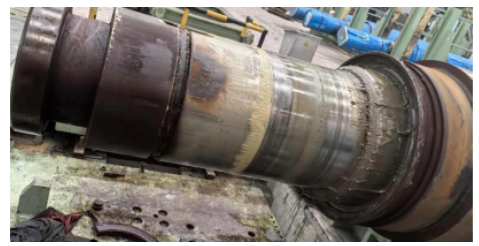
2. Four-row cylindrical roller bearings
• Load-carrying characteristics: Have extremely high radial load-carrying capacity, but cannot bear axial loads on their own. They must be used in combination with thrust bearings (such as double-row angular contact ball bearings, deep groove ball bearings, etc.).
• Performance advantages: High manufacturing accuracy and high limit speed. Due to the small friction between the cylindrical rollers and the retaining edges, they generate less heat during high-speed operation, and their high-speed performance is significantly superior to that of tapered roller bearings.
• Precision control: Usually, an interference fit between the inner ring and the roller neck is adopted to avoid the "run-out of the inner ring" phenomenon; and the inner ring can be simultaneously ground with the roller surface of the rolling mill, greatly improving the rotational accuracy and axial guiding accuracy of the rolling mill system and solving the sliding friction problem between the tapered inner ring and the rolling mill diameter.
• Installation and maintenance: Installation and disassembly are relatively convenient. After disassembly, the internal rolling elements and the wear conditions of the inner and outer raceways can be directly observed, allowing for timely and accurate maintenance plans to be made.
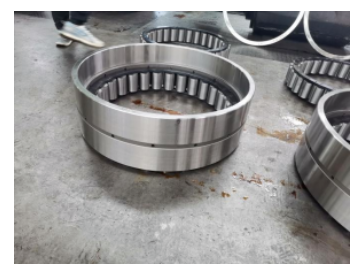
• Structural Limitations: An additional thrust bearing needs to be configured, which results in an increase in the overall length of the rolls, an increase in the equipment weight, and higher requirements for the installation space of the rolling machine and the width of the bearing housing.
III. Evaluation of the Application Scheme for Broad-Flange Plate Working Roll System
1. The decisive influence of rolling speed on the selection of parameters
When the rolling speed exceeds 30m/min, the high-speed performance advantages of the four-row cylindrical roller bearings become prominent. If the four-row conical roller bearings are still used at this point, the temperature rise caused by sliding friction due to the axial load will become a bottleneck restricting production capacity. Therefore, for the high-speed and high-yield wide and thick plate finishing rolling units, the cylindrical roller bearing solution should be given priority.
2. Comparison of Typical Configuration Schemes
• Scheme 1 (Traditional Compact Type): Utilizes four-row tapered roller bearings. Suitable for medium and low-speed wide and thick plate rolling mills or opening mills. This scheme has a compact structure and is convenient for changing rolls. However, in high-load and high-speed conditions, it is necessary to pay special attention to preventing roller overload burnout and cage fatigue failure.
• Scheme 2 (High Precision Type): Uses "four-row cylindrical roller bearings + double-row angular contact ball bearings (operating end) + deep groove ball bearings (transmission end)". This configuration fully utilizes the high radial load-bearing capacity of cylindrical bearings and the high axial positioning ability of angular contact ball bearings. It not only adapts to high-speed rolling but also can effectively share the load when the rolling force suddenly changes. It has high operational reliability and is currently the mainstream trend for thin plate and high-precision wide and thick plate six-roll cold rolling mills.
3. Accuracy and Lifespan
For the wide and thick plate production line that aims for the highest surface quality and thickness accuracy, the configuration of four rows of cylindrical roller bearings combined with thrust bearings can provide a smaller axial clearance and higher stiffness. Meanwhile, the split structure design enables the bearing housing and the rolls to be freely combined, significantly reducing the roll changing time and improving the operation rate of the rolling mill.
IV. Comprehensive Selection Suggestions and Conclusion
For the bearing selection of the working roll system of a wide plate rolling mill, the following principles are recommended:
1. For high-speed and high-precision conditions: If the rolling mill is designed with a high rolling speed (30m/min) and has strict requirements for the thickness and shape accuracy of the plate and strip, it is strongly recommended to adopt a combined configuration of "four-row cylindrical roller bearings + special thrust bearings". Although this scheme increases the initial design complexity and axial dimensions, it has significant comprehensive economic benefits in terms of long-term reliability, low failure rate, and product quality assurance.
2. For medium and low-speed heavy-load conditions: If the installation space and investment budget are limited, or the rolling mill is mainly used for medium and low-speed rough rolling stages, four-row conical roller bearings are still a mature and reliable choice. However, during operation, the bearing clearance must be strictly monitored, lubrication and cooling management must be strengthened, and advanced technologies such as oil-gas lubrication must be adopted to improve the lubrication conditions of the friction pair and extend the service life.


WeChat official account

Scan and focus on us
Address:24th floor, Tianjin Property Building, 590 Shengan Road, Huishan District, Wuxi City, Jiangsu Province Tel : 13861477666 E-mail : jsdmdbearing@163.com ©2020 江苏帝蒙德轴承有限公司. 版权所有 苏ICP备16008043号-4