I. Determination of Preload
Although there are various effects of preloading on rolling bearings, excessive preloading will increase the frictional wear and temperature rise of the bearings, and reduce their fatigue life. The preloading amount should be selected based on the working conditions, preloading purpose, and usage requirements. It should not only achieve the preloading purpose but also meet the requirements in terms of life, friction torque, and temperature rise. Generally speaking, in high-speed and light-load conditions, or in cases where higher rotational accuracy is required, a light preloading should be selected. In medium-speed and medium-load or low-speed heavy-load conditions, when the purpose is to improve the supporting stiffness, a medium preloading or heavy preloading should be selected. The preloading purpose to prevent gyroscopic rotation can be selected according to the calculation method for preventing gyroscopic rotation; the preloading purpose to reduce the slippage of the rolling elements can be selected based on the relevant analysis and calculation results.
When determining the preload, first calculate the preload force required to achieve the optimal combination of rigidity, bearing life, and operational reliability. Then, calculate the preload force to be used when adjusting the bearing during installation. During installation, the bearing should be at the ambient temperature and without operating load.
The appropriate preload at normal operating temperature depends on the load of the bearing. Angular contact ball bearings or tapered roller bearings can simultaneously withstand radial and axial loads. Under radial load, a force acting axially will be generated in the bearing, and it is generally borne by the second bearing, which faces the opposite direction to the first bearing. A pure radial displacement of one bearing ring relative to another bearing ring means that half of the bearing's circumference (i.e., half of the rolling components) bears the load, and the axial force generated in the bearing is: Fa = 0.5 (Fr/Y)
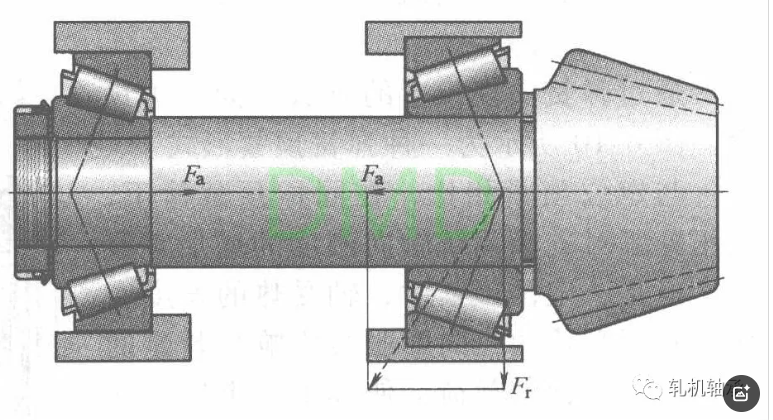
The radial load of the bearing
Among them, Fr represents the axial load of the bearing; Y is the axial coefficient, whose value is generally provided by the bearing manufacturer. When a single bearing is required to bear the radial load Fr, in order to reach the basic load rating, a certain external axial force Fa must be applied. If the applied external force is small, the number of rolling components supporting the load will be fewer, and the load capacity of the bearing will accordingly decrease.
In a bearing configuration consisting of two single-row angular contact ball bearings or two tapered roller bearings placed back-to-back or face-to-face, each bearing must bear the axial force from the other bearing. When the two bearings are the same, the radial load acts on the centers of the two bearings. If the bearing configuration is adjusted to zero clearance, the load can be automatically distributed when half of the rolling components bear the load. In other load conditions, especially when there is an external axial load, a preload must be applied to the bearing to compensate for the elastic deformation of the bearing caused by the axial load, and a more favorable load distribution can be achieved on the other bearing without an axial load.
The preload also increases the rigidity of the bearing configuration. Rigidity is not only affected by the elasticity of the bearing, but also by the elasticity of the shaft and bearing housing, the installation fit of the bearing ring, and the elasticity deformation of all other components including the support in the stress field. These factors all affect the elasticity of the entire shaft system. The axial and radial elasticity of the bearing depends on the internal design, namely the contact conditions (point contact or line contact), the number and diameter of the rolling components, and the contact angle. The larger the contact angle, the higher the axial rigidity of the bearing.
If, as a preliminary estimate, it is assumed that there is a linear relationship between elasticity and load, the comparison shows that under the same external axial force K, the axial displacement of the preloaded bearing configuration is smaller than that of the non-preloaded bearing configuration.
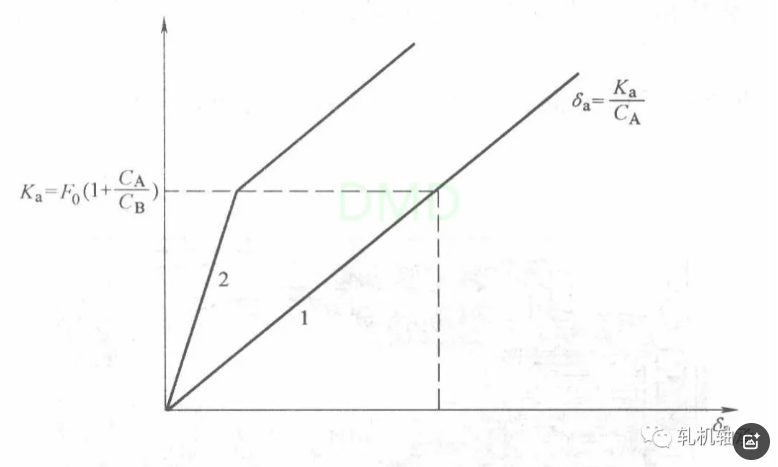
The relationship between the preload force and the preload path in preloaded configuration bearings
II. Adjustment of Preload
The preload adjustment is divided into individual adjustment and overall adjustment.
1. Make individual adjustments
When using separate adjustment, each bearing configuration is adjusted separately using nuts, washers, spacer rings, deformation rings, etc. The measurement and inspection steps ensure that the deviation value of the nominal preload force obtained is as small as possible. The advantage of separate adjustment is that individual components can reach the standard tolerance and can achieve the required preload force with appropriate precision.
Depending on the number of bearings to be measured, there are different methods:
(1) Use the preload pre-tension to adjust. This adjustment method is often used when the bearing configuration components are pre-assembled. For example:
1) The preload of the differential bearing configuration can be obtained by inserting a spacer ring between the outer and inner rings of the two bearings.
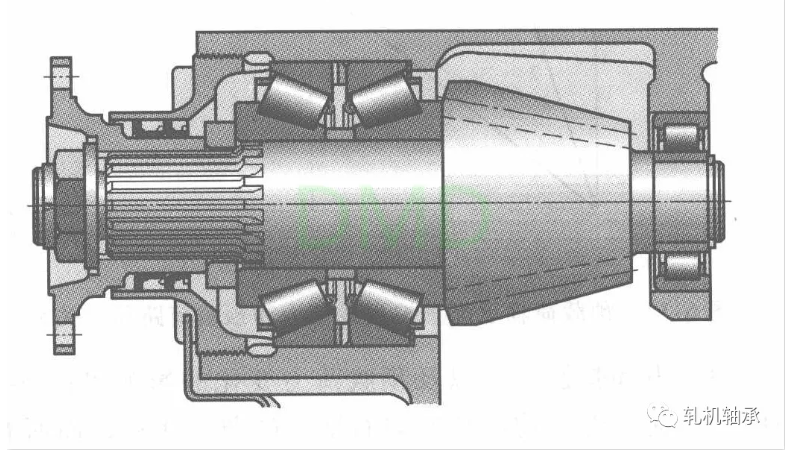
The inner or outer rings of the two bearings are directly inserted into the spacer ring to obtain the preload force.
Insert adjustment washers between the bearing seat shoulder and the bearing outer ring, or between the protective cover and the bearing seat.
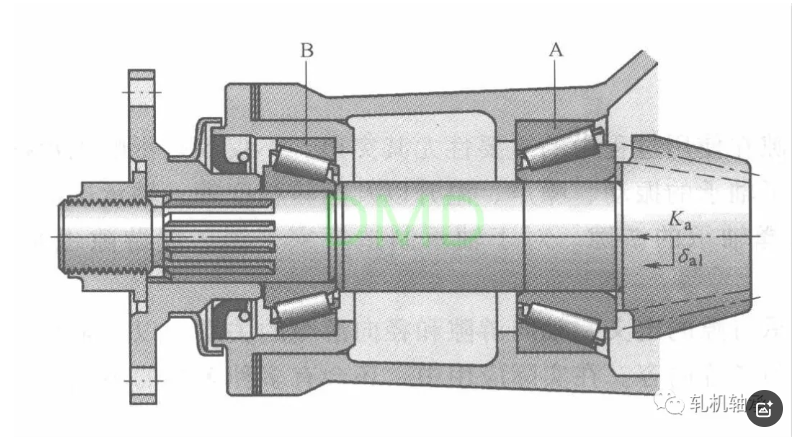
Insert a regulating washer between the bearing seat shoulder and the outer ring of the bearing to obtain the preload force.
2) Insert spacer rings between the shaft shoulder and one bearing inner ring, or between the inner rings of the two bearings.
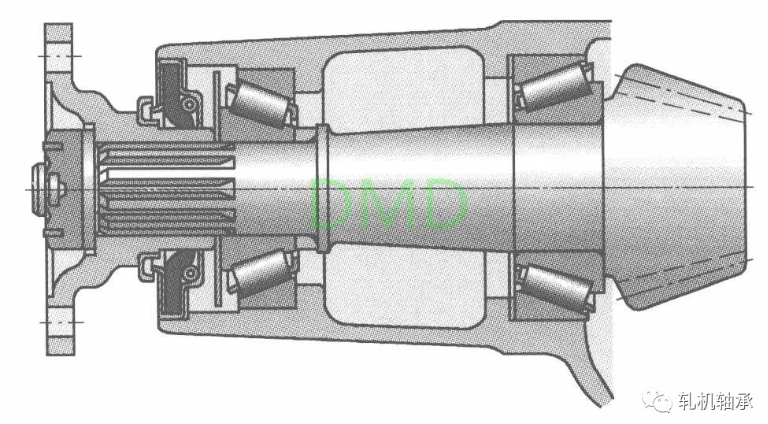
3) Insert spacer rings between the shaft shoulder and one bearing inner ring or between the inner rings of the two bearings.
The width of the gasket, intermediate ring or spacer ring is determined by the following factors:
1) The distance between the shaft and the bearing shoulder.
2) The total width of the two bearings.
3) The preload amount corresponding to the required preload force (axial displacement).
4) The correction factor for the preload amount considering the thermal expansion during operation.
5) The manufacturing tolerances of all components and the measurement values before installation.
6) The correction factor for the loss of preload force after a certain period of operation.
(2) Adjusting using friction torque This method is commonly used in series production. It requires less time and has the potential for higher degree of automation. Since there is a definite relationship between the bearing preload and the friction torque, if the friction torque is continuously monitored, once it reaches the corresponding friction torque required for the preload, the adjustment can be stopped. However, different anti-corrosion agents, different lubrication conditions, or different speeds may result in different friction torques.
(3) Adjusting using direct force measurement Because the purpose of bearing adjustment is to form a certain preload in the bearing, using methods to directly form the preload or directly measure the preload force seems more practical. However, in practical applications, methods of indirectly adjusting by using preload or friction torque are more suitable because these methods are simple and cost-effective.
2. Overall adjustment
When using this adjustment method, also known as "random statistical adjustment", bearings, shafts, bearing housings, spacer rings or spacer sleeves, etc. are produced in normal quantities, randomly assembled, and these components can be completely interchangeable. For tapered roller bearings, interchangeability also extends to the outer and inner ring components. To avoid economically producing high-precision bearings and related components, it can be assumed that the limit values of tolerances rarely occur simultaneously statistically. However, if a concentrated preload force is desired, the manufacturing tolerances must be reduced. The advantage of overall adjustment is that there is no need to check during the installation of the bearing, and no additional equipment is required.


WeChat official account

Scan and focus on us
Address:24th floor, Tianjin Property Building, 590 Shengan Road, Huishan District, Wuxi City, Jiangsu Province Tel : 13861477666 E-mail : jsdmdbearing@163.com ©2020 江苏帝蒙德轴承有限公司. 版权所有 苏ICP备16008043号-4