Generally, rolling bearings have a certain amount of clearance when in operation. However, to achieve specific purposes, when configuring the bearings, certain adjustment methods are used to enable the bearings to obtain a certain internal load and be used in a negative clearance state. This usage method is called pre-tightening. Pre-tightening can improve the rotational accuracy of the bearings, increase the rigidity of the bearing installation, and reduce the vibration of the shaft during machine operation.
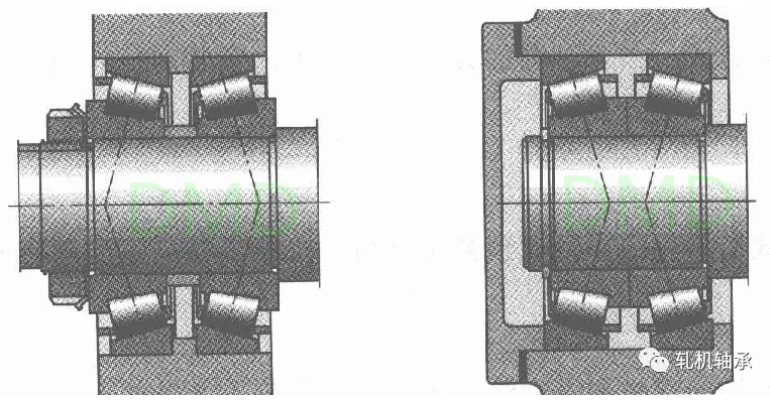
The above picture shows the pre-tightening of a rolling bearing.
The purpose of pre-tightening:
1. Improve rotational accuracy. After the bearing is pre-tightened, the internal clearance is eliminated. Each rolling element bears a certain preload and supports the raceway from all directions, which can enhance rotational accuracy, enable the shaft to be accurately positioned radially and axially, and improve the rotational accuracy of the shaft.
2. Increase stiffness. The contact points between the rolling elements and the raceways are all elastic contacts, and the rolling elements can be regarded as springs. Bearings with clearance only have several spring supports in the direction of force application. After pre-tightening, the bearing has spring supports in all directions and has a certain preload, and the number of rolling elements bearing the load is more than when there is clearance. Therefore, the stiffness can be improved. In ball bearings, the relationship between the contact deformation of the balls and the load is nonlinear. As the preload increases, the contact stiffness increases.
3. Increase the lifespan of the bearing. After pre-tightening, the number of loaded rolling elements increases, and the load on each rolling element decreases. At the same time, the load can be distributed more evenly across each rolling element, thus improving the lifespan of the bearing.
4. Enhance the damping and reduce noise. Pre-tightening establishes a stable oil film between the rolling elements and the raceway, increasing the damping between the rolling elements and the raceway. This can improve the dynamic characteristics of the supporting structure and reduce noise.
5. Improve the dynamic performance of angular contact ball bearings. In angular contact ball bearings operating at high speeds, appropriate pre-tightening can prevent the steel balls from undergoing gyroscopic rotation, prevent or reduce the translational slipping of the steel balls, and also control the self-rotational sliding of the steel balls.
6. Suppress vibration patterns and friction wear. Suitable for non-vibration processing of low roughness machining machines, or for mechanisms that need to control friction wear due to frequent starting and stopping.
7. Control the slipping phenomenon of the rolling elements' revolution and rotation. For example, in high-frequency electric motors, it is used in radial thrust ball bearings and cylindrical roller bearings on jet engines, etc.
8. Compensate for wear during operation. During operation, the bearing will experience wear and thus increase the clearance. This situation can be compensated by pre-tightening.
Pre-tightening methods:
According to the method of applying the pre-tightening load, axial pre-tightening is divided into positioning pre-tightening and pressure pre-tightening.
I. Axial preload
According to the method of applying the preload, axial pre-tightening is divided into two types: positioning pre-tightening and pressure-locked pre-tightening.
1. Positioning and Pre-tightening
The method of applying preload to the bearing by adjusting the length of the sleeve or the thickness of the washer is called positioning pre-tightening. For paired double-acting bearings, a certain amount of pre-deformation is removed from the inner ring end faces of the two bearings during assembly, and then pre-tightening is achieved. This also belongs to positioning pre-tightening.
Through positioning pre-tightening, the axial stiffness of the supporting system can be significantly improved. It should be noted that for radial thrust ball bearings with applied preload, the radial stiffness of the supporting system also significantly increases. The load and deformation relationship of roller bearings is approximately linear, so applying preload to a single roller bearing cannot increase the stiffness of the roller bearing. However, for paired tapered roller bearings, when using positioning pre-tightening, it can significantly increase the axial stiffness of the supporting system like ball bearings. This is because in pre-tightened conditions, the axial working load is borne by both bearings together. The pre-tightening principle of paired tapered roller bearings is the same as that of ball bearings. Under the same axial working load, the axial displacement of the supporting system with pre-tightening is only half of that without pre-tightening. Therefore, through positioning pre-tightening, the axial stiffness of the tapered roller bearing supporting system can be doubled. The removal of preload from a bearing in the pre-tightened supporting system when it is completely free from load is called unloading load.
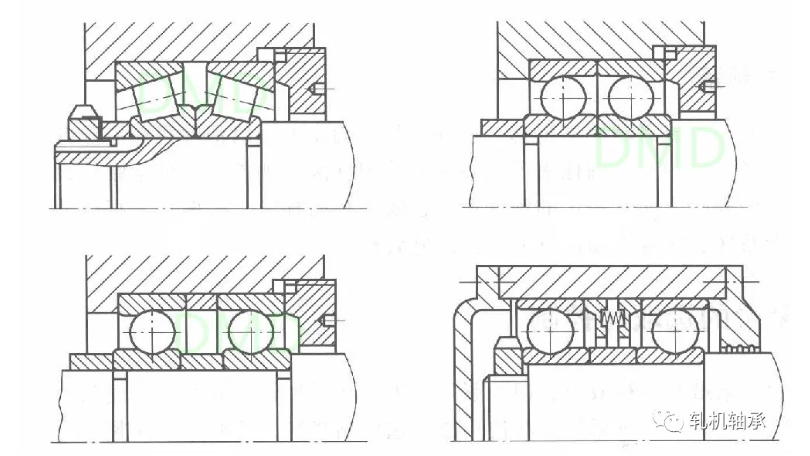
The pre-tightening structure of the bearing
2. Constant pressure pre-tightening
The method of achieving preload through a spring is called constant-pressure preload. Compared with positioning preload, at the same preload, constant-pressure preload does not significantly increase the axial stiffness of the support system. However, during positioning preload, the length change of the shaft due to heating and the radial expansion of the ring due to heating will affect the change in preload. In addition, the axial load will cause the preload of one bearing to decrease or be loosened. However, constant-pressure preload does not have these problems. When high stiffness is required, positioning preload is generally used; in high-speed operation, when high rotational accuracy is required and to prevent the rolling elements from sliding, constant-pressure preload is preferable.
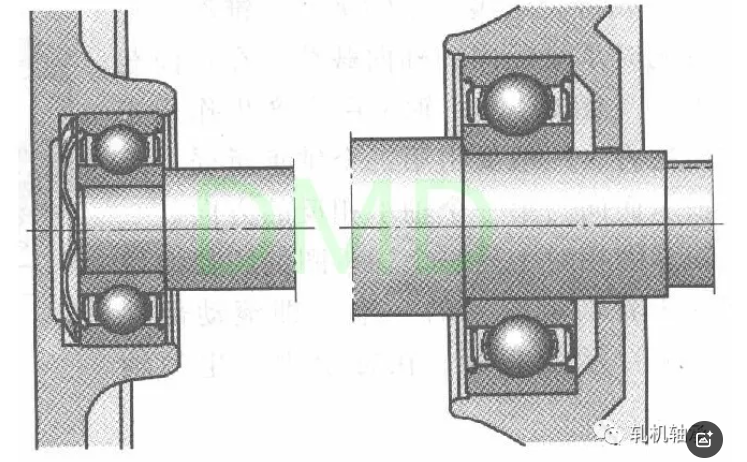
II. Radial Pre-tightening
The method of eliminating radial clearance and achieving pre-tightening by using interference fit, or by using locking rings or release rings to expand the inner ring is called radial pre-tightening. For high-speed radial cylindrical roller bearings with hollow cylindrical rollers, in the design of the bearing structure, there is a certain pre-deformation between the rollers and the inner and outer rings after assembly, which also belongs to radial pre-tightening. Radial pre-tightening is rarely used. Its purpose is to expand the load-bearing area of the rolling elements, reduce the slipping of the rolling elements, and improve the rotational accuracy, etc.
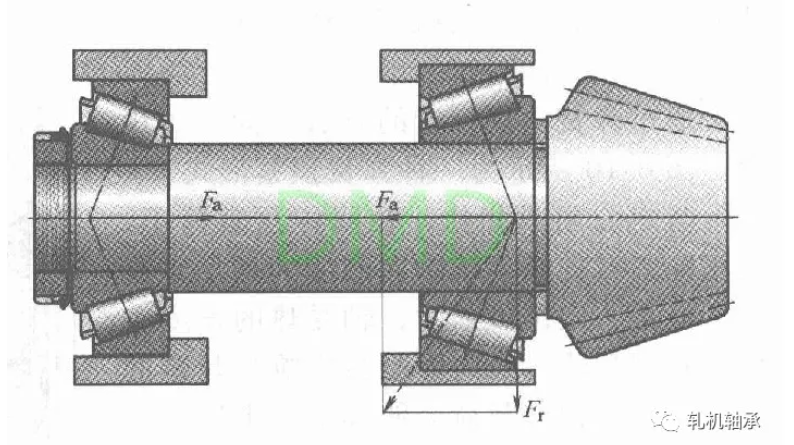
Radial pre-tightening
III. Radial Pre-tightening
The method of eliminating the radial clearance and achieving pre-tightening by using interference fit, or by using locking rings or release rings to expand the inner ring is called radial pre-tightening. For high-speed radial cylindrical roller bearings with hollow cylindrical rollers, in the design of the bearing structure, there is a certain pre-deformation between the rollers and the inner and outer rings after assembly, which also belongs to radial pre-tightening. Radial pre-tightening is rarely used. Its purpose is to expand the load-bearing area of the rolling elements, reduce the slipping of the rolling elements, and improve the rotational accuracy, etc.


WeChat official account

Scan and focus on us
Address:24th floor, Tianjin Property Building, 590 Shengan Road, Huishan District, Wuxi City, Jiangsu Province Tel : 13861477666 E-mail : jsdmdbearing@163.com ©2020 江苏帝蒙德轴承有限公司. 版权所有 苏ICP备16008043号-4