The backing bearings are multi-row cylindrical roller bearings. The precision required for the bearings themselves is extremely high (the manufacturing accuracy reaches the P4 level). Especially, after eliminating the radial clearance, the cross-sectional height (T value) from the inner diameter to the outer diameter is particularly important. On each shaft, the T value is controlled within 0.005mm. For high-precision bearings, the maintenance during use also needs to be strictly controlled. Bearings without maintenance will seriously affect the online service life of the bearings. See the figure below;
Figure 1 Figure 2
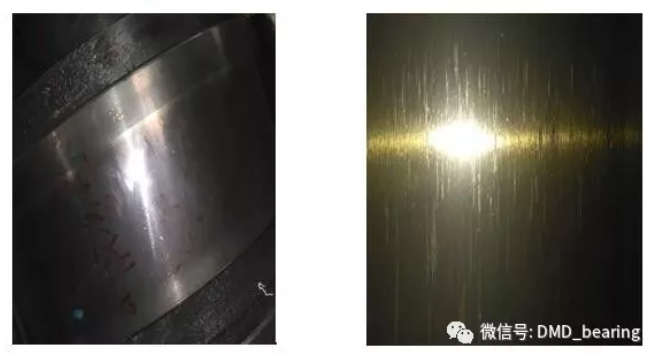
Figure 3 Figure 4
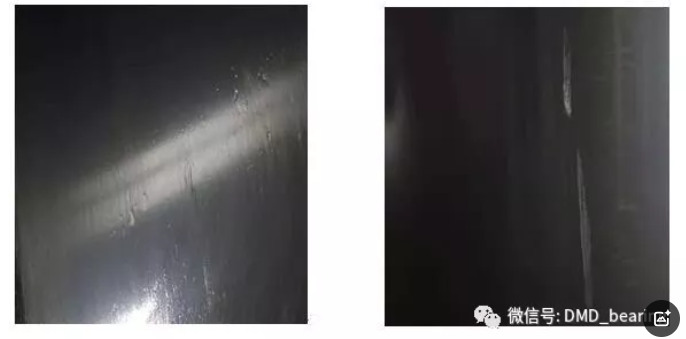
Figure 5 Figure 6
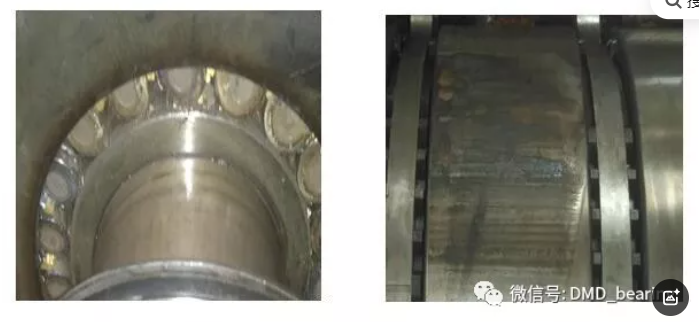
This backing bearing is installed in six sets on a single core shaft. The bearings shown in Figures 1 to 4 have been in use for three months, while the bearings in Figures 5 and 6 have been in use for two and a half months, resulting in the bearings becoming dry and seizing due to lack of oil. If maintenance is timely, such wear marks will not form on the outer surface of the bearing, and timely maintenance will prevent the bearing from seizing due to lack of oil while in use.
To avoid the occurrence of the above phenomena, regular maintenance is necessary. After long-term service of the backing bearing, a maintenance process has been summarized.
1) Bearing installation: Install according to the box sequence number, install the entire set on the machine, remove the entire set from the machine, and when a single set of bearings is damaged and needs to be replaced, check the outer diameter size of the new bearing to ensure that the difference between the outer diameters of the new and old bearings is no more than 0.005 um. Record the time of bearing installation, and for a single damaged bearing, record the cause of damage, damage time, installation position, and the time and position of the new bearing being installed.
2) Bearing disassembly: Place the disassembled bearings neatly in a row according to the disassembly sequence, and record the disassembly time. After the first round of disassembly and maintenance, do not allow the bearings on the core shaft to be mixed and displaced when reinstalled on the machine. During the second, third, and fourth rounds of disassembly and maintenance, check the cross-sectional height of the complete set of bearings, re-arrange the bearings, and then reinstall them for operation.
3) Cleaning the bearings: First, wipe off the oil dirt on the outside of the bearing, then place the complete set of bearings in the oil tank in sequence and clean the outside of the bearings, dry the oil stains, and then clean the inside of the bearings with cleaning oil. For the final cleaning, use clean cleaning oil to clean the bearings to ensure the purity of the inside of the bearings. Cleaned bearings should be covered with plastic or kraft paper on-site to prevent further contamination.
4) Check the lubrication system of the rolling mill, check the oil circuit of each bearing one by one, and for the backing bearings, each round of online use is very long, ensuring adequate oil supply during operation. Only with sufficient oil supply can the phenomena shown in Figures 5 and 6 not occur.
5) The inner race of the backing bearing has four load zones. The inner ring should be rotated 90° or 120° when installed on the machine to adjust the load zone.
6) Bearing maintenance time: Lubricate with emulsified oil (for plain carbon steel, 20-25 days, for high-quality steel, 20 days), lubricate with oil (for plain carbon steel, 1 month, for high-quality steel, 20 days). Bearings due to long-term alternating rolling on the machine should undergo natural aging after disassembly to release internal stress. The aging time should be more than 7 days.
7) The disassembly and assembly of the backing bearing is a complex and meticulous task. It is necessary to ensure that the disassembly and cleaning maintenance are carried out by a dedicated person.
8) The backing bearing should have a separate installation site for disassembly and assembly. The site should be clean and spacious.
9) The backing bearing is used in groups, and it is inconvenient to disassemble and assemble on flat ground. A bearing disassembly pit can be dug to facilitate disassembly and installation, and it can also ensure safe production.
10) When the equipment is shut down for a long time, all bearings should be removed for maintenance. The emulsified oil contains water and the cooling water contains chemical components that are prone to corroding the bearings.
11) Maintenance purpose: 1. Check the usage condition of the bearing. 2. Release the internal stress. 3. Check the lubrication condition.
12) After cleaning the outer surface of the bearing, check if there are any indentations, peeling, or scratches on the surface. Bearings with severe surface damage should not be installed on the machine. Make a numbering record and apply anti-rust oil for return to the factory for repair.
13) Under normal circumstances, after three or four rounds of use, the backing bearing should be sent to the factory for maintenance if the usage condition is poor.
14) The backing bearings without flanges or movable retaining rings cannot bear axial loads by themselves. Therefore, for this structural form of bearing, a copper or engineering plastic thrust washer must be used. The washer should be placed between the outer ring end face and the saddle. The backing bearing must be inspected after running for a certain period of time.
15) The backing bearings in the frame bear different loads. The bearings on the support with higher loads need to be exchanged with those on the support with lower loads periodically. And each time after disassembly and before reinstallation, the inner ring should be rotated by 90 degrees. This will ensure uniform wear of the bearing.
16) By shaping the bus line contour, the optimal stress distribution can be achieved for both uniform load and skewed load on the entire outer diameter surface.


WeChat official account

Scan and focus on us
Address:24th floor, Tianjin Property Building, 590 Shengan Road, Huishan District, Wuxi City, Jiangsu Province Tel : 13861477666 E-mail : jsdmdbearing@163.com ©2020 江苏帝蒙德轴承有限公司. 版权所有 苏ICP备16008043号-4