A customer provided a set of deep groove ball bearings with a size of 6203. After a 2138-hour durability test in the customer's experiment, abnormal noises occurred, requiring failure inspection and analysis to identify the possible root cause of the failure.
After our disassembly, the sealing component only had a severely deformed steel reinforced frame remaining, and the rubber was missing. See Figure 1; the inner race track showed obvious dullness, the rolling traces were difficult to identify, the original processing texture was no longer visible, and many fine indentations could be seen on the track, see Figure 2; the outer race track showed obvious dullness, very similar to the inner race track, and there were many particles adhered together in the sealing groove, see Figure 3; some of the outer race track surfaces within the range of approximately 90° showed obvious damaged surfaces, see Figure 4; the inner hole surface of the inner race had micro-damage corrosion, see Figure 5.
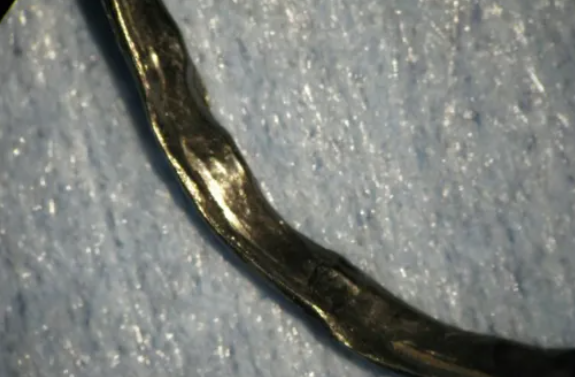
Figure 1
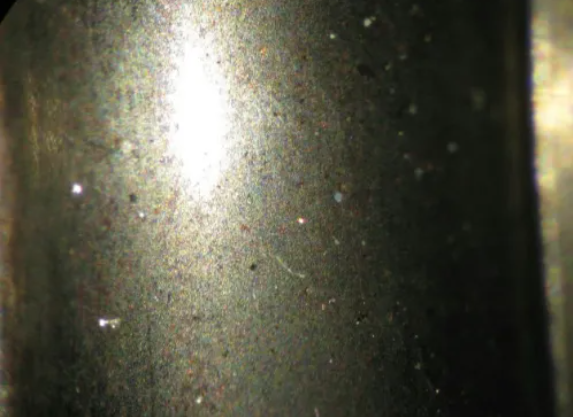
Figure 2
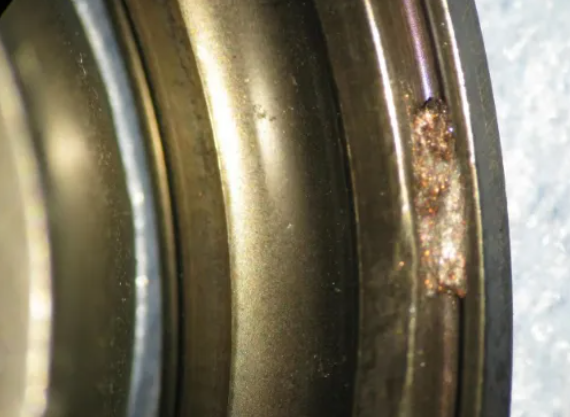
Figure 3
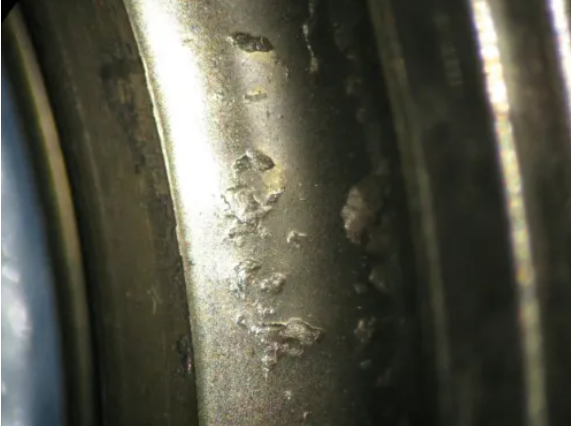
Figure 4
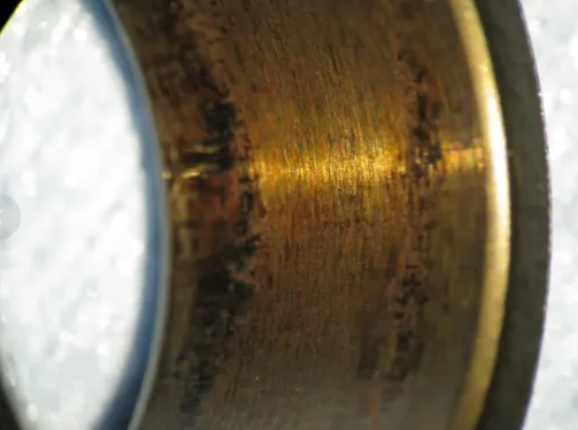
Figure 5
After analysis, it was found that none of the sealing components of the bearings had sealing lips, and one of them was severely deformed; the surface of the outer raceway was severely damaged, and there was micro-corrosion on the inner surface of the inner ring; since there was no lubricant in the bearings, chemical analysis could not be conducted. Based on the relevant application conditions, the most likely cause is the abnormal increase in temperature, which may be due to the fracture of the cage, external contamination, insufficient pre-tightening of the bearings, etc., which further led to lubrication failure, causing damage to the surface of the outer raceway, and ultimately resulting in the failure of the bearings.


WeChat official account

Scan and focus on us
Address:24th floor, Tianjin Property Building, 590 Shengan Road, Huishan District, Wuxi City, Jiangsu Province Tel : 13861477666 E-mail : jsdmdbearing@163.com ©2020 江苏帝蒙德轴承有限公司. 版权所有 苏ICP备16008043号-4