The selection of cold rolling mill bearing types is highly targeted and follows certain patterns. During the rolling process of the mill from the low-speed starting stage to the high-speed operation stage, it will be subjected to extremely high radial loads and constantly changing axial loads. To adapt to these special working conditions, the roller bearings must have a wide contact surface design to reduce the stress on the bearing contact surface. High-strength bearing material with excellent performance must be selected, along with optimized internal geometric contour surface design and processing technology, as well as excellent cage performance (ensuring the integrity of the cage shape throughout the entire life of the bearing). The main types of bearings used include four-row cylindrical roller bearings, four-row conical roller bearings, large-angle double-row conical roller bearings, and other thrust bearings and positioning bearings, etc.
The bearing box of the intermediate roll in the cold rolling process has aged, and the positioning of the outer ring of the thrust bearing is skewed.
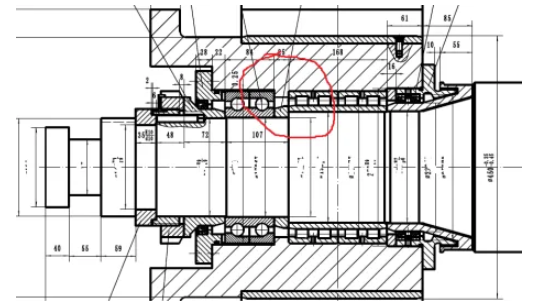
The intermediate roll operation side bearings of the six-roll reversible cold rolling mill for thin plates are configured with radial FC structure of four columns of cylindrical roller bearings and thrust double-row angular contact ball bearings (with double outer ring structure). Due to the long-term use of the bearing housing, it has been in use for ten years. There are severe wear and damage on the inner hole shoulder of the bearing housing, causing the outer ring positioning of the thrust bearing to be skewed. As a result, the bearings are prone to short-term peeling and damage.
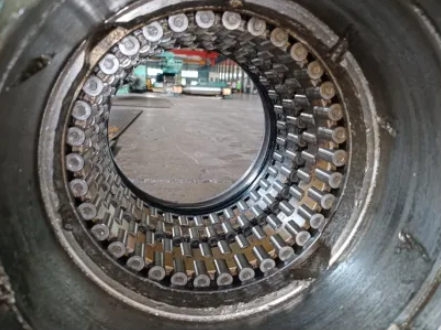
The thrust double-row angular contact ball bearing is installed into the bearing housing. It needs to be installed with the outer ring pressed in. If the shoulder is damaged, it will cause the outer ring to be skewed and not be firmly pressed, and the outer raceway of the bearing will undergo local wear or circumferential damage due to the local force.
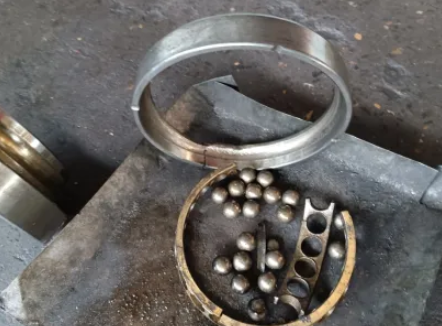
The bearing housing was disassembled on-site. The outer side columns rotated smoothly. The outer ring of the inner side close to the shaft shoulder had axial cracks and occurred at local peeling areas. The failure of multiple sets of thrust bearings at the site was basically consistent.
On-site analysis shows that the thrust double-row angular contact ball bearing on the operating side of the intermediate roller has an issue with the positioning of the inner ring. Due to the failure of the positioning of the inner ring's outer ring, the rotational axis of the inner ring's outer ring becomes tilted relative to the inner ring. This causes local stress on the outer raceway of the outer ring, resulting in local peeling and damage on the outer raceway of the bearing.
The improvement measures include replacing the existing bearing seats, or implementing a technical solution for the intermediate roll and the roll bearing by adopting a four-row conical roller bearing configuration.
The spacer ring of the supporting roller is worn, the end face of the bearing cage is scratched, and the rollers are broken
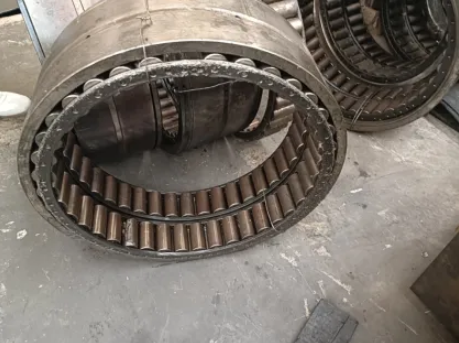
The rollers of the four-row cylindrical roller bearings of the cold-rolled 1050 supporting roller have been crushed, and the cage of the bearing near the roller surface has suffered scratching.
On-site inspection revealed the failure of the damaged bearing. The cage of the bearing was severely scratched near the roller surface. Among them, 2 of the rolling elements had already broken, while the other rolling elements appeared to be in good condition.
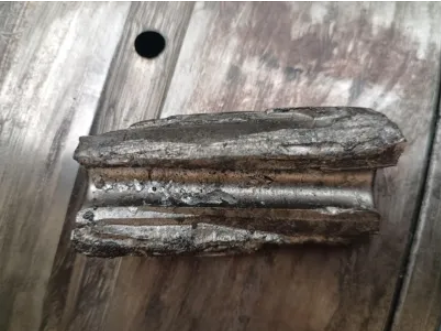
By reviewing the assembly drawings of the rolls and comparing them with the actual on-site rolls, it was observed that the bearing cage was in contact with the spacer ring near the roll surface. The scraping of the cage was caused by the collision with the spacer ring. After the cage was scraped, some of the cage pins became skewed, causing the rolling elements to vibrate and fail to rotate smoothly. Axial wear marks appeared on the surface of the rolling elements, and ultimately, due to stress concentration, the rolling elements fractured axially.
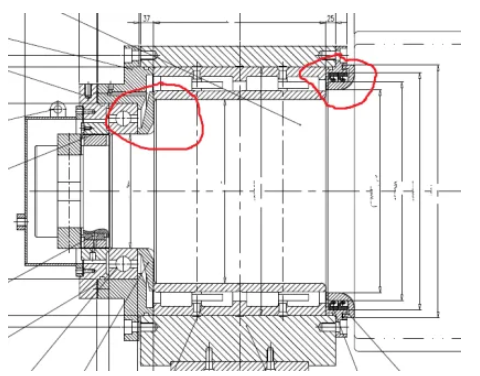
By reviewing the bearing drawing design and the assembly drawing of the rolls, it was found that there is a 4mm gap between the end face of the spacer ring and the cage. Theoretically, they should not be able to touch each other.
During the on-site inspection, it was observed that the end face of the spacer ring in contact with the positioning bearing on the left side was worn and its size had shrunk. After investigation, it was found that the customer replaced the spacer ring spare part with 45# steel at the site. This material has low hardness and will cause friction between the spacer ring end face and the end face of the positioning bearing (the positioning bearing and the roll neck have a clearance fit, and the spacer ring on the left side is axially positioned). As a result, it will wear out rapidly.
When the left spacer ring is worn out, the bearing housing will move closer to the roller surface. Since the height of the right spacer ring is close to that of the cage, the end face of the cage will come into contact with it and then cause collision and scraping.
Usually, when the inner ring of the roller bearing is in a clearance fit and is positioned by the end face of the spacer ring, the material of the spacer ring will be 42CrMo. The contact surface with the bearing needs to undergo surface quenching treatment, with a hardness close to that of the bearing surface. Generally, it is Shatto hardness HS81-82, in order to prevent abnormal wear of the spacer ring.


WeChat official account

Scan and focus on us
Address:24th floor, Tianjin Property Building, 590 Shengan Road, Huishan District, Wuxi City, Jiangsu Province Tel : 13861477666 E-mail : jsdmdbearing@163.com ©2020 江苏帝蒙德轴承有限公司. 版权所有 苏ICP备16008043号-4