In the fields of industrial manufacturing and equipment operation and maintenance, the repair of core components' damage has always been a crucial link for cost reduction and efficiency improvement, as well as ensuring the continuity of production. Traditional welding repair, which has been used for many years, lacks technological innovation. Under high-temperature, high-pressure, and severe wear conditions, it gradually reveals shortcomings such as significant thermal deformation, low bonding strength, and short lifespan. However, laser cladding repair, leveraging the precise control characteristics of high-energy lasers, has achieved a new technological leap. It has formed all-round advantages in technical performance, economic cost, production efficiency, and environmental protection and safety, and has become the preferred choice for the repair of high-end equipment.
Technical Performance: A Quality Leap from "Marginal Compatibility" to "Customized Enhancement"
Laser cladding repair, leveraging the core advantages of metallurgical bonding, low thermal damage, and high-performance coatings, has completely overcome the performance limitations of traditional welding. It ensures that the performance of the repaired parts is not lower than that of new products or even undergoes upgraded enhancement.
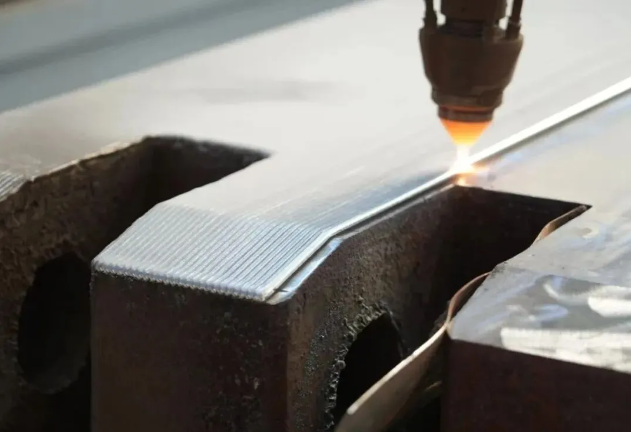
In terms of strength and reliability, there is a significant difference between the two. Traditional welding by using a high-temperature electric arc to melt the material and build up a coating results in a local bonding between the coating and the base material, with a low bonding strength. Under vibration and impact conditions, it is prone to peeling and delamination, just like sticking tiles on a wall - over time, they are bound to fall off. In contrast, laser cladding uses a high-energy laser beam to make the cladding material and the surface layer of the base material melt simultaneously, and then forms a bonding layer through rapid solidification. The bonding strength is much higher than that of traditional welding, and the coating and the base material have no physical interface, so there is almost no risk of peeling.
Low thermal damage and high precision control are another core advantage of laser cladding. Traditional welding has a large heat input and a wide heat-affected zone, which easily causes part deformation and cracking. After repair, a lot of time is needed to correct the deformation, and even high-precision components with excessive deformation may be directly scrapped. Laser cladding, through precise temperature control, strictly limits the heat-affected zone. The deformation of the base material is less than that of traditional welding. Combined with six-axis联动 robots and laser displacement sensors, it can precisely repair irregular structures such as grooves, steps, and deep holes, without the need for subsequent correction processes, and perfectly suits the repair of high-precision components such as machine tool guideways and hydraulic cylinder piston rods.
The customized adaptability of coating performance is far beyond what traditional stick welding can achieve. Traditional stick welding materials are limited to a single type and mostly consist of general alloys, making it difficult to meet the complex requirements of wear resistance, corrosion resistance, and high-temperature resistance. Laser cladding can precisely customize the coating system according to the working conditions. For high-temperature wear conditions, a composite coating is selected, which significantly increases the temperature resistance and reduces the wear amount compared to traditional stick welding layers. For acid and alkali corrosive environments, an anti-corrosion coating is adopted, with better corrosion resistance than 304 stainless steel, and the service life is extended by more than twice. At the same time, through rapid solidification to refine the grains, the coating hardness can reach a higher level, and the wear resistance is 3-5 times that of traditional stick welding layers, achieving the effect of "repair and strengthening immediately".

WeChat official account

Scan and focus on us
Address:24th floor, Tianjin Property Building, 590 Shengan Road, Huishan District, Wuxi City, Jiangsu Province Tel : 13861477666 E-mail : jsdmdbearing@163.com ©2020 江苏帝蒙德轴承有限公司. 版权所有 苏ICP备16008043号-4