Overview of the scene:
The 61940 positioning bearing on the transmission side of the rolling mill's roller system was found to have a cracked inner ring during the maintenance of the lower machine.
Observation Description:
Upon inspection of the 61940 failed bearing, the outer ring appears to be in good condition, while the cage and rolling elements are also in good condition. However, the inner ring has suffered from a through-crack. One side of the inner ring's end face is severely scratched and has burrs. After magnifying the end face for observation, near the outer chamfer, there are fine radial cracks in the circumferential direction (this is consistent with the obvious characteristics of the bearing end face and the mating surface, where due to relative motion, there is friction resulting in an increase in temperature, which causes frictional heat cracks on the bearing end face, and due to the crack, the bearing ring breaks axially and is damaged).

The failure phenomenon of the damaged bearing is that the inner ring has axial cracking. When observing the end face of the inner ring of the bearing under magnification, one side remains intact and retains the original grinding state as it was at the time of manufacture.
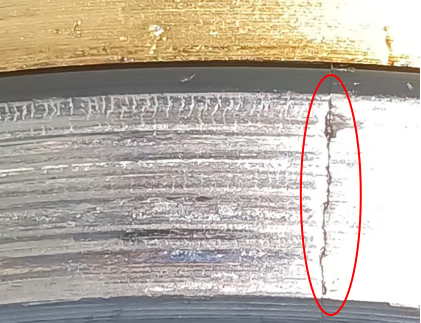
Another closer observation reveals that near the near-external chamfer of the end face, there are obvious radiating scratch marks, which are consistent with the typical scratch marks and comminuted damage on the bearing end face caused by friction.
Reason analysis:
By observing the failure phenomenon of the damaged bearing, it can be seen that after the one side end face of the bearing and the mating surface have relative rotational movement, frictional heat cracks are generated. Due to the stress release at the crack location, the inner ring of the bearing undergoes axial cracking.
The inner ring's cracks indicate the characteristic of end face friction-induced wear and damage. It is determined that the main cause is the loosening of the axial locking of the inner ring, resulting in relative sliding friction between one end face and the end face of the mating component.
Preventive measures:
1. When installing, the end face of the bearing inner ring should be pressed and installed to ensure that the relative rotation movement between the matching surface can not occur in use, so as to prevent abrasion and heating due to mutual friction.
2. Check whether the hardness of the mating parts is compatible to prevent creeping wear caused by insufficient hardness, which may lead to excessive clearance.
3. Install the stop key to ensure that the inner ring of the bearing and the roller rotate synchronously.


WeChat official account

Scan and focus on us
Address:24th floor, Tianjin Property Building, 590 Shengan Road, Huishan District, Wuxi City, Jiangsu Province Tel : 13861477666 E-mail : jsdmdbearing@163.com ©2020 江苏帝蒙德轴承有限公司. 版权所有 苏ICP备16008043号-4