The selection of cold rolling mill roll bearings is highly targeted and follows certain patterns. During the rolling process of the mill from the low-speed starting stage to the high-speed operation stage, it will be subjected to extremely high radial loads and constantly changing axial loads. To adapt to these special working conditions, the roll bearings must have a wide contact surface design to reduce the stress on the bearing contact surface. High-strength bearing material must be selected, along with optimized internal geometric contour surface design and processing technology, as well as excellent cage performance (ensuring the integrity of the cage shape throughout the entire life of the bearing). The main types of bearings used include four-row cylindrical roller bearings, four-row conical roller bearings, large-angle double-row conical roller bearings, and other thrust bearings and positioning bearings, etc.
During the operation of the roller bearing, due to various factors, the service life did not reach the ideal state, or the bearings were damaged and failed within a short period, or they affected the normal operation of the equipment. The following is a case analysis of a site that was observed by our client.
The interference fit of the inner ring of the lithium battery roller press bearing is insufficient, which can easily lead to eccentricity of the inner ring and excessive vibration.
The roller bearings of lithium battery roller press usually adopt four-row cylindrical roller bearings of P4 or P5 precision and paired double-row needle roller bearings. The radial runout is strictly required. Generally, the radial runout of the roller surface is within 1-2 μm. When the interference fit between the roller neck of the roller press and the inner ring of the bearing is insufficient, it is easy to cause the inner ring of the bearing to creep relative to the roller neck of the roller press.
When the inner ring undergoes rotation, it will cause eccentricity in the inner ring of the bearing (relative to the roller surface), resulting in radial runout of the roller surface. At this point, it is necessary to re-grind the inner ring of the bearing and the roller surface, or replace the bearing with a new one.
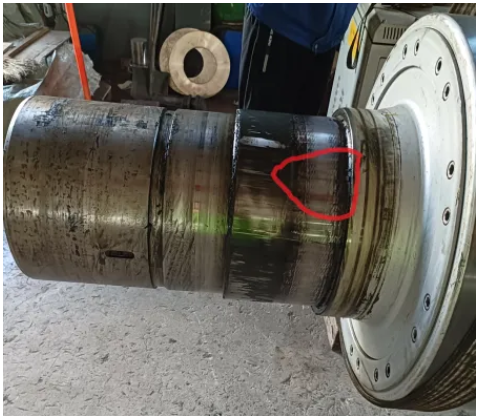
Due to the eccentricity of the inner ring and the excessive radial runout, after removing the inner ring, it was observed that there were obvious signs of the inner ring running off the sleeve on the roller neck.
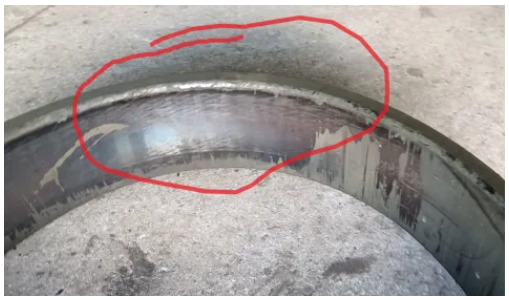
Ball bearings, with P4 grade dimensional accuracy of the bearings. Due to insufficient interference fit between the rolls, there are also signs of runout on the inner diameter surface of the bearing inner ring.
On-site analysis shows that the large roller surface vibration is caused by the movement of the inner ring of the bearing, which causes the inner ring surface to be eccentric relative to the roller surface. To eliminate the eccentricity, before grinding the roller face, the inner ring of the bearing should be replaced and ground.
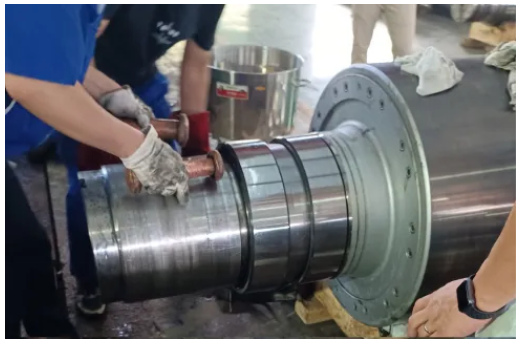
Replace the new needle roller bearings. Follow the specifications to heat and install the inner ring of the bearings. After installation, grind the inner ring and the roller surface of the rolls, and the runout requirements of the roller surface of the rolls are met.


WeChat official account

Scan and focus on us
Address:24th floor, Tianjin Property Building, 590 Shengan Road, Huishan District, Wuxi City, Jiangsu Province Tel : 13861477666 E-mail : jsdmdbearing@163.com ©2020 江苏帝蒙德轴承有限公司. 版权所有 苏ICP备16008043号-4