The selection of cold rolling mill bearing types is highly targeted and follows certain patterns. During the rolling process of the mill from the low-speed startup stage to the high-speed operation stage, it will be subjected to extremely high radial loads and constantly changing axial loads. To adapt to these special working conditions, the roller bearings must have a wide contact surface design to reduce the stress on the bearing contact surface. High-strength bearing material with excellent performance must be selected, along with optimized internal geometric contour surface design and processing techniques, as well as excellent cage performance (ensuring the integrity of the cage shape throughout the entire life of the bearing). The main types of bearings used include four-row cylindrical roller bearings, four-row conical roller bearings, large-angle double-row conical roller bearings, and other thrust bearings and positioning bearings, etc.
The cylindricality of the inner hole of the roller bearing housing exceeds the tolerance limit, and the outer raceway of the bearing has flaking and cracking.
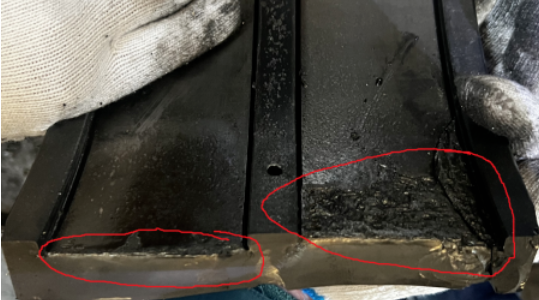
Inspect the double raceway peeling in the outer raceway load zone. The peeling is in a fan shape, with one raceway having a longer peeling area and the other having a shorter one. This fan-shaped peeling is usually related to the drop of the load area in the inner hole of the bearing housing and the presence of a taper.
The outer ring shows axial through cracking and fragmentation in multiple pieces. The fracture surface section shows no signs of grinding burn or cracks during bearing manufacturing, which conforms to the symptom of stress concentration release fracture. The stress point is at the edge of the outer raceway where peeling occurs. The stress concentration is related to insufficient support of the outer diameter of the bearing by the inner hole of the bearing seat or the presence of protrusions. It is necessary to check for potential points by comparing with the outer diameter.
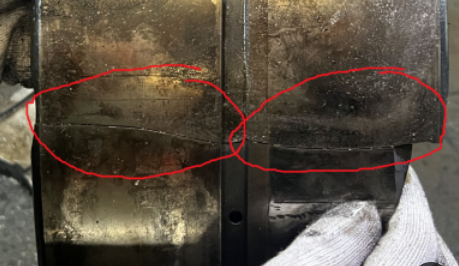
By examining the outer diameter of the fracture fragments, it can be observed that numerous stress marks are present. These marks can be precisely matched and correspond to the peeled-off areas of the outer raceway and the fracture stress points.
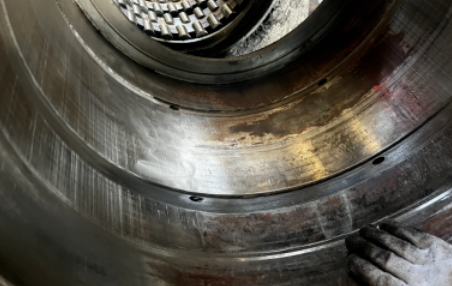
Then, we inspected the inner hole of the bearing housing. After the inner hole was ground, it was found that there was an unevenness in the hole diameter. There were still burrs and protrusions on the inner hole, and the cylindricality of the hole diameter was above 0.35.
In conclusion, the outer ring of the roller bearing cracked. By observing the varying lengths of the worn circumferences of the raceways, it was indicated that the included angles of the two raceways' load-bearing areas were different (the inner hole of the bearing housing has a taper, commonly known as a trumpet mouth, with a smaller diameter, a larger included angle, and a greater load-bearing capacity, resulting in severe peeling and a large peeling area). Due to peeling and uneven force distribution, stress concentration is likely to occur, and the bearing may peel off or fracture in the short term.


WeChat official account

Scan and focus on us
Address:24th floor, Tianjin Property Building, 590 Shengan Road, Huishan District, Wuxi City, Jiangsu Province Tel : 13861477666 E-mail : jsdmdbearing@163.com ©2020 江苏帝蒙德轴承有限公司. 版权所有 苏ICP备16008043号-4