The selection of cold rolling mill roll bearings is highly targeted and follows certain patterns. During the rolling process of the mill from the low-speed starting stage to the high-speed operation stage, it will be subjected to extremely high radial loads and constantly changing axial loads. To adapt to these special working conditions, the roll bearings must have a wide contact surface design to reduce the stress on the bearing contact surface. High-strength performance bearing materials must be selected, along with optimized internal geometric contour surface design and processing techniques, as well as excellent cage performance (ensuring the integrity of the cage shape throughout the entire life of the bearing). The main types of bearings used include four-row cylindrical roller bearings, four-row conical roller bearings, large-angle double-row conical roller bearings, and other thrust bearings and positioning bearings, etc.
1.The transmission side of the supporting roller is subjected to a large axial force, causing the roller to become stuck and burn out.
The roller bearings vary in load-bearing capacity depending on their position and the design of the bearing structure. For instance, a four-row cylindrical roller bearing is typically used to support the rollers and mainly withstands the radial rolling force. Such bearings can only bear a very small axial force. When the axis of the bearing is at an inclined angle to the axis of the roller, or when subjected to a large axial force, the outer raceway guard of the bearing will overheat and be damaged.
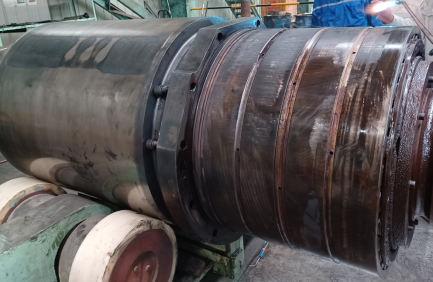
The supporting rollers of the five-pass cold-rolled thin plate mill got abnormally stuck. After the bearing box detached, the outer components of the transmission side bearings and the rolling elements and the inner ring of the bearing could no longer be separated. The analysis concluded that the four columns of cylindrical roller bearings on the transmission side were burned out and stuck. The bearings were disassembled on-site and the reasons for the bearing damage were analyzed.
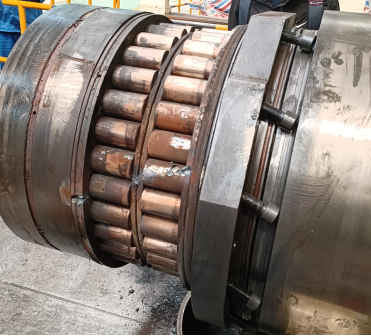
First, disassemble the outer ring of the bearing on the side close to the roller surface. After observation, it was found that there was no adhesion between the outer ring of the bearing and the rolling elements. The raceways and rolling elements showed color changes, and their shapes were good. Further analysis and judgment revealed that the burn damage points of the bearing were on the two raceways on the side away from the roller surface.
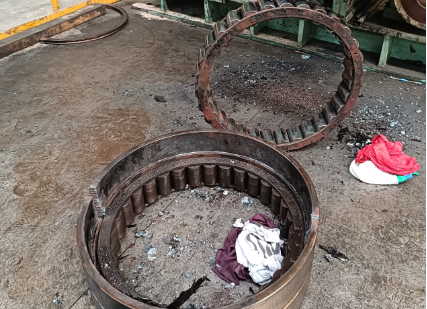
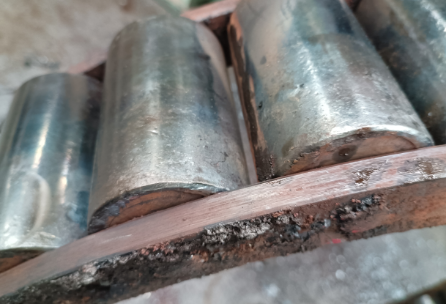
By further disassembling the outer ring raceway and the associated rolling elements, they can be removed for inspection. Observe the wear and adhesion conditions of the raceway. The shape of the raceway is intact, without peeling off. Only the third row of raceways shows adhesion. The outer ring flange and the end face of the rolling elements are severely worn. Because the flange can only withstand a very small axial load during operation and there is sliding friction between it and the end face of the rolling elements. Based on the damage of the bearing, it is analyzed that the shaft received a large axial force, and the bearing flange was heated due to sliding friction, resulting in overheating and burnout of the bearing.
There are no positioning bearings on the transmission side of this continuous rolling equipment. The axial position is limited by hydraulic pull rods. The analysis suggests that it might be due to improper limit of the pull rods that the bearing received a large axial force.


WeChat official account

Scan and focus on us
Address:24th floor, Tianjin Property Building, 590 Shengan Road, Huishan District, Wuxi City, Jiangsu Province Tel : 13861477666 E-mail : jsdmdbearing@163.com ©2020 江苏帝蒙德轴承有限公司. 版权所有 苏ICP备16008043号-4